I’m Matthew, Associate Director at The Hanwell Group. I’m a quantitative social researcher using insights into public opinion to address strategic and political challenges. I’m also an Honorary Research Fellow at the Mile End Institute, Queen Mary University of London.

My academic research has been published in world-renowned peer-reviewed journals including Perspectives on Politics, Political Behavior, Political Studies, Public Opinion Quarterly, and European Journal of Political Research, among others.
I am also an active commentator on, and analyst of, politics and current affairs. I have contributed to political coverage in the Financial Times, BBC News, New Statesman, Politics Home, Times Radio, and elsewhere, as well as producing my own informative short-form video content on social media.
Research

Electoral Hope
It is well established in political science that those who favour an election outcome tend to say it has a higher chance of success than those who oppose it. This tendency towards so-called ‘wishful thinking’ is often treated as a problem for democracy because it shows that voters are, as the term suggests, irrational. In this article, I make the case that partisan electoral expectations are significant not because they demonstrate widespread irrationality, but because they show how voters make sense of their role in democracies. I provide an alternative account of partisan electoral expectations as following a principle of electoral hope. On this account, partisan electoral expectations are rational in a practical, if not necessarily theoretical, sense.

Hope, Optimism, and Expectations for the Political Future
Expectations of what the future holds are a significant driver of political behavior. It is therefore important to understand the sources of those expectations. In this paper, we explore the psychological dispositions driving positivity about the political future. We draw on psychologists’ distinction between optimism—a dispositional belief that good things will happen, come what may—and hope—a trait of envisioning, pursuing and believing one’s goals to be achievable. We assess pre-registered hypotheses about the distinct influences of optimism and hope on valence expectations—beliefs about whether there will be good or bad societal outcomes—and electoral expectations—beliefs about likely election outcomes—in a representative-sample survey experiment in the United Kingdom. We find that optimism drives positive valence expectations, but hope drives partisan electoral expectations. Indeed, partisan bias in electoral expectations is exhibited only by those scoring higher in hope. We show experimentally that positive information from polls and expert commentary dampens this impact of hope by raising the expectations of the otherwise unhopeful. Our findings suggest that so-called ‘wishful thinking’ about election outcomes might stem from a sense of agency around electoral politics, but that this sense of agency does not extend to how citizens envision society’s prospects.
Policy Discounting Across and Beyond the Lifespan
European Journal of Political Research
Wishful Thinking in Response to Events
Electoral Studies
Voters Share Polls That Say What They Want to Hear
International Journal of Public Opinion Research
Misinformation in Experimental Political Science
The American Political Science Association recently cautioned against the use of misinformation(giving research participants false information about the state of the world) in research with human subjects. This recommendation signals a growing recognition, as experimental research itself grows in prevalence in political science, that deceptive practices pose ethical problems. But what is wrong with misinformation in particular? I argue that while this question certainly has an ethical dimension, misinformation is bad for inference too. Misinformation moves us away from answering questions about the political world effectively. I propose a straightforward, intuitive solution to this twofold problem: tell the truth.

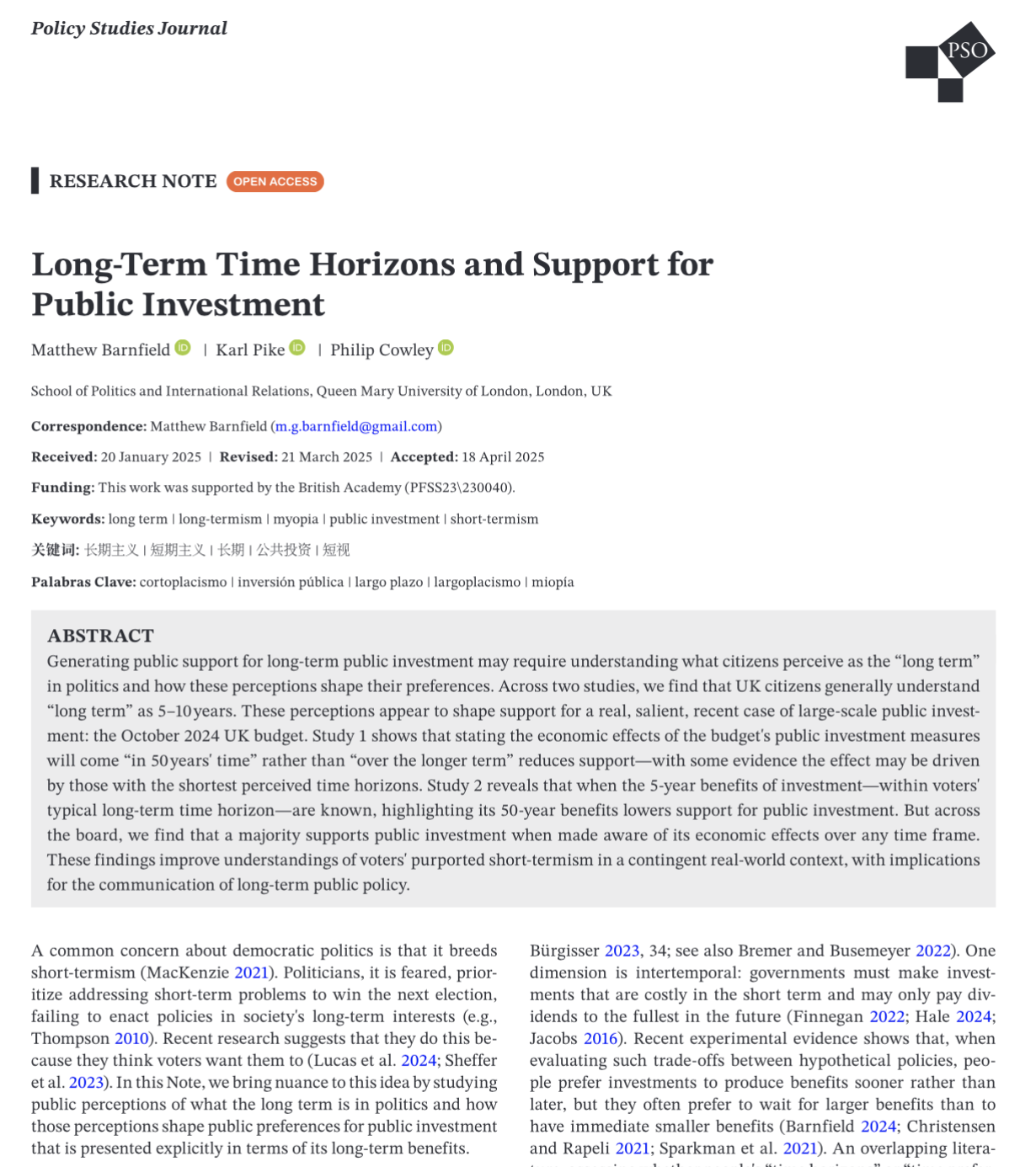
Long-Term Time Horizons and Support for Public Investment
Generating public support for long-term public investment may require understanding what citizens perceive as the “long term” in politics and how these perceptions shape their preferences. Across two studies, we find that UK citizens generally understand “long term” as 5–10 years. These perceptions appear to shape support for a real, salient, recent case of large-scale public investment: the October 2024 UK budget. Study 1 shows that stating the economic effects of the budget's public investment measures will come “in 50 years' time” rather than “over the longer term” reduces support—with some evidence the effect may be driven by those with the shortest perceived time horizons. Study 2 reveals that when the 5-year benefits of investment—within voters' typical long-term time horizon—are known, highlighting its 50-year benefits lowers support for public investment. But across the board, we find that a majority supports public investment when made aware of its economic effects over any time frame. These findings improve understandings of voters' purported short-termism in a contingent real-world context, with implications for the communication of long-term public policy.
Momentum in the Polls Raises Electoral Expectations
Electoral Studies
Effects of Forecasts on Expectations
Public Opinion Quarterly
Think Twice Before Jumping on the Bandwagon
Political Studies Review

Media